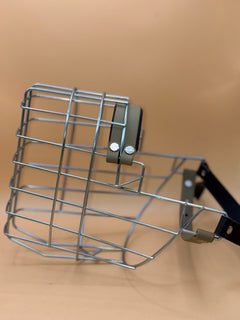
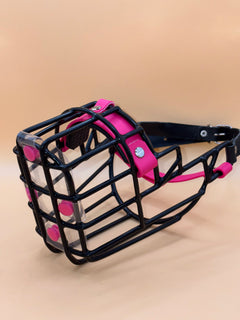
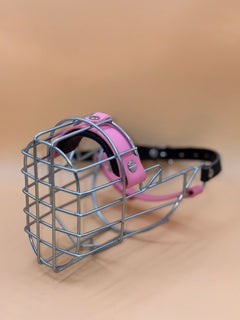

Frequently asked questions about secure muzzles & wire muzzles
Do you have questions about muzzles? Here you will find answers to the most important questions about safe muzzles, wire muzzles, the right size, adjustment, and muzzle requirements in Germany.
Orders & Returns
How long does delivery take?
Personalized products are made individually for you – delivery usually takes 10–14 days. Other products are shipped within 3–7 business days.
Who pays for return shipping?
The customer is responsible for the cost of return shipping. We do not cover return shipping costs.
Can I return or exchange personalized products or custom-made muzzles?
No. Personalized products are custom-made for you. Customized muzzles are also specifically bent to fit your dog's head shape – therefore, returns or exchanges are excluded. For B-stock or special offers, we will indicate this separately.
Size & Fit
How to find the right size muzzle for your dog?
Measure four values on your dog:
- Snout length: Place the measuring tape 1.5 cm in front of the eyes and run it over the bridge of the nose to the tip of the nose.
- Snout width: Measure at the widest part of the snout, about 1.5 cm in front of the eyes.
- Head width: Measure at the widest point, about 1.5 cm in front of the ears.
- Snout height: Measure from the bridge of the nose to the deepest point of the jowls (1.5 cm in front of the eyes).
The muzzle must have a distance of 0.5–1.5 cm from the nose so that your dog can pant.
How can I tell if a muzzle fits correctly?
A well-fitting muzzle meets the following criteria:
✓ The dog can open its mouth wide and pant unhindered
✓ The nose pad does not constantly touch the muzzle
✓ The muzzle does not press into the eyes
✓ The cheek straps rest on both sides – a finger should fit through on both sides without the muzzle pressing or having too much play
✓ It cannot be slipped off over the nose (after adjustment)
✓ It cannot be slipped off over the ears (after adjustment)
✓ No chafing occurs
How do I properly fit a muzzle?
Pay attention to these checkpoints:
- Distance from nose pad to eyes: 0.5 to 1.5 cm depending on dog size. Too little distance can lead to irritation.
- Distance from nose sponge to muzzle: 0.5 to 1.5 cm – the muzzle must not rest directly on the nose.
- Throat strap: Snug but not constricting. 1–2 fingers should fit underneath.
- Neck strap: Must sit directly behind the skull.
- Cheek straps: Should fit snugly on both sides – a finger should fit through on both sides without the muzzle pressing or having so much play that it wobbles.
- Lower metal brace: Should not permanently rest on the neck in a neutral state.
Wire muzzle & materials
Why is a wire muzzle the safest muzzle?
Wire muzzles (also known as metal muzzles) are the only muzzles that are truly bite-proof. The robust metal construction offers maximum security for dogs with serious intent to harm.
At the same time, the open structure allows for optimal air circulation – your dog can pant and drink without problems, and you can even reward them through the grate.
Another advantage: wire muzzles can be individually adjusted by carefully bending them into shape. This allows for a perfect fit for any head shape – especially for broad-headed breeds like bulldogs, pit bulls, or similar. Since incorrect adjustment can damage the muzzle or worsen its fit, we recommend leaving the adjustment to a professional.
What are the advantages of a wire muzzle over other materials?
✓ Absolutely bite-proof – the safest muzzle ever
✓ Optimal air circulation for panting
✓ Drinking is possible
✓ Rewarding through the grid is possible
✓ Individually adjustable by careful bending
✓ Easy to clean and very hygienic
✓ Durable and robust
What muzzle materials are there and what are they suitable for?
Wire/Metal: Completely bite-proof, best choice for dogs with biting potential. Suitable for continuous use.
Plastic (e.g., Baskerville): Usable as a temporary solution or for short periods. Not suitable for dogs with serious destructive intent. Can break during collisions.
Leather: Comfortable due to soft material. Not bite-proof, becomes porous from saliva, and requires intensive care.
Biothane: Easier to care for than leather
Nylon/Loop Muzzles: ⚠️ Only suitable for a few minutes! The dog cannot pant
How do I clean a wire muzzle?
Wire muzzles are particularly easy to clean:
- Rinse with clear water after each use
- Clean with mild soap if heavily soiled
- Allow to dry thoroughly to prevent rust formation
- Nose pad can be washed separately
Rubberized wire muzzles are even easier to clean and offer additional weather protection.
Muzzle requirement & law
When is a muzzle required in Germany?
In Germany, there is no nationwide muzzle requirement – regulations vary by federal state and municipality.
Muzzle requirements generally apply:
• On public transport (Deutsche Bahn, many public transport networks)
• For dangerous dog breeds in many federal states
• In certain public places depending on the municipality
• In public buildings (administrative buildings, etc.)
Exceptions: assistance and guide dogs, as well as small dogs in transport boxes.
What is the difference between a muzzle requirement and a muzzle-carrying requirement?
Muzzle Requirement: The dog must wear a muzzle in certain places or situations – mandatory and without exception.
Muzzle-on-Hand Requirement: You must have a suitable muzzle with you and be able to put it on if necessary – for example, if staff requests it or a critical situation arises.
In public transport, the muzzle-on-hand requirement often applies – whether the muzzle must be worn is at the discretion of the transport staff.
Does my dog need a muzzle on the train?
Yes, the following applies to Deutsche Bahn:
• Dogs not travelling in a transport box must be leashed AND wear a muzzle
• Small dogs (up to cat size) in a transport box travel free of charge and without a muzzle
• Larger dogs require a half-fare ticket
Exceptions: Guide dogs for the blind and marked assistance dogs do not need to wear a muzzle and travel free of charge.
Tip: If you do not have a muzzle with you, the train staff may ask you and your dog to exit the train at the next stop.
Is a muzzle animal cruelty?
No! A well-fitting muzzle is not animal cruelty. A suitable muzzle hardly restricts the dog – they can breathe, pant, eat, and drink with it.
Animal cruelty only arises from:
• Incorrect models such as muzzle loops (which prevent panting)
• Poorly fitting muzzles (too tight, pinching)
• Lack of or incorrect training
A muzzle is not a sign of aggression, but of responsibility. It can even give the dog more freedom – for example, if it allows them to run off-leash.
Why should EVERY dog be muzzle-trained?
There are many situations in which a muzzle makes sense – regardless of whether the dog is aggressive:
• Mandatory in public transport (train, bus, mountain railways)
• Vet visits – pain can lead to snapping
• International travel with mandatory muzzles (e.g. Italy)
• Protection against poisoned bait during walks
• After operations as a lick guard instead of a cone
• In stressful situations for safety
• With new dogs whose behavior is not yet known
A positively trained muzzle is like a collar or harness – a completely normal aid.
Are muzzle loops a good alternative to a muzzle?
No, muzzle loops are NOT a suitable alternative!
They keep the muzzle closed, preventing the dog from panting. Since dogs regulate their body temperature through panting, this can become dangerous after just a few minutes.
Muzzle loops are only suitable for very short-term use (a few minutes) at the vet – never for walks, training, or extended use.
Important: Always use a proper basket muzzle that allows panting!